Front load Bins, widely employed for municipal waste collection, commercial refuse disposal, and recycling programs, are containers designed for mechanical lifting and emptying by specialized collection vehicles. Their role demands a combination of strength, durability, corrosion resistance, and ease of handling, all of which are directly influenced by the materials used in their manufacture. The choice of material affects not only the structural integrity and service life of the bin but also its weight, maintenance requirements, environmental footprint, and cost-effectiveness. In practice, manufacturers select from a range of materials, each offering distinct advantages and trade-offs, to match the operational demands of different waste management scenarios.
1. High-Strength Low-Alloy Steels
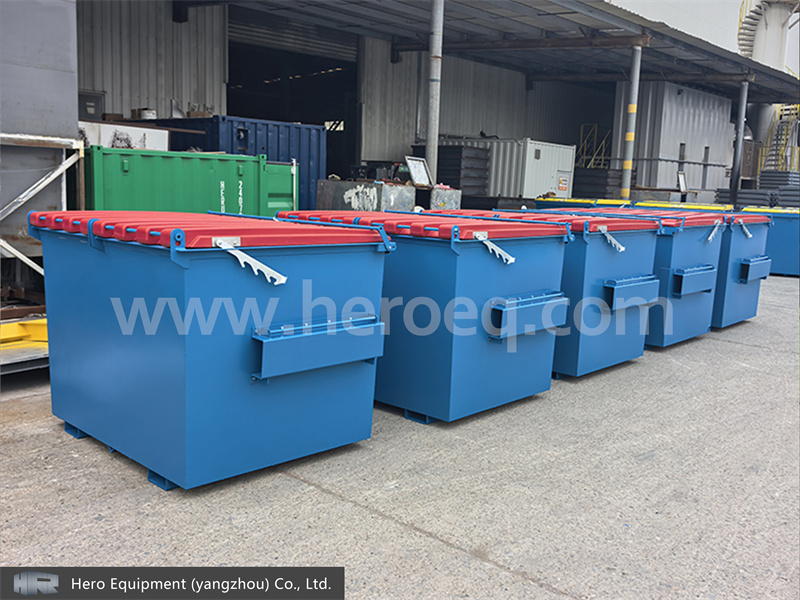
Steel remains the predominant material for heavy-duty front load bins, particularly in applications involving large volumes, dense waste, or frequent mechanical handling. High-strength low-alloy (HSLA) steels are favored for their superior mechanical properties relative to conventional carbon steels. HSLA steels achieve higher yield and tensile strength through small additions of alloying elements such as manganese, vanadium, niobium, and molybdenum, without significant weight penalty. This allows manufacturers to use thinner gauge sheets while maintaining structural rigidity, reducing overall bin weight and easing manual or mechanical handling.
The inherent toughness of HSLA steels enables bins to withstand impacts from compaction blades in collection trucks, dropping of materials during loading, and abrasive wear from gritty refuse. Their fatigue resistance is also advantageous given the cyclic loading associated with repeated lifting, dumping, and transit over uneven roads. However, steel is susceptible to corrosion in the presence of moisture, chemicals, and road salts, necessitating protective coatings to ensure long-term durability.
2. Stainless Steels
For environments where corrosion poses a severe threat to service life and hygiene standards, stainless steels are employed in front load bin construction. Stainless steel’s defining characteristic is its high chromium content, which forms a passive oxide layer on the surface, conferring exceptional resistance to rust, staining, and many corrosive substances. Common grades used include austenitic stainless steels such as type 304 and, in more aggressive conditions, type 316, which contains molybdenum for enhanced resistance to pitting and crevice corrosion in chloride-rich environments.
Stainless steel bins are prevalent in food processing waste streams, healthcare facilities, coastal municipalities where salt spray is prevalent, and industrial sites handling corrosive byproducts. Their non-porous surface also discourages bacterial growth, aiding in sanitation and simplifying cleaning protocols. Although stainless steel entails higher material and fabrication costs, its longevity and minimal maintenance often justify the investment in applications where failure due to corrosion would be costly or hazardous.
3. Aluminum Alloys
Aluminum alloys provide an attractive alternative where weight reduction is a priority without compromising on strength. Through alloying with elements such as manganese, magnesium, and silicon, aluminum achieves a favorable strength-to-weight ratio, making it ideal for situations requiring manual handling or where vehicle payload limits are critical. Aluminum front load bins are lighter than their steel counterparts, reducing fuel consumption during collection and easing maneuverability for users.
Despite being lighter, aluminum alloys exhibit good corrosion resistance due to the formation of a protective oxide layer, which self-repairs if scratched. This natural resistance makes aluminum suitable for outdoor use in temperate climates. However, aluminum has lower stiffness than steel, so designers may use additional reinforcement—such as extruded ribs or thicker gauge sheets—to prevent deflection under load. Its lower melting point and susceptibility to galvanic corrosion when in contact with certain metals must also be considered in mixed-material systems.
4. Molded Polyethylene and Other Thermoplastics
Rotationally molded polyethylene has become a popular material for medium-duty front load bins, particularly in residential waste collection and light commercial use. The rotational molding process creates seamless, one-piece containers with uniform wall thickness, eliminating weak points associated with welded seams. High-density polyethylene (HDPE) offers excellent impact resistance, remaining intact even under low-temperature conditions where brittle fracture might occur in other plastics.
Polyethylene is inherently resistant to a wide range of chemicals, moisture, and UV radiation, especially when formulated with stabilizers and antioxidants. This resistance simplifies outdoor deployment without the need for painting or extensive coating maintenance. The material’s smooth, non-absorbent surface resists adhesion of waste residues, facilitating cleaning and reducing odor retention. While polyethylene bins generally have lower load capacities than steel or aluminum, their durability, lightweight nature, and resistance to corrosion make them a cost-effective solution for many municipal programs.
5. Fiber-Reinforced Composite Materials
Composite materials combining resins with reinforcing fibers such as glass or carbon are increasingly explored for front load bins in niche applications. These materials offer high strength and stiffness relative to weight, along with excellent corrosion resistance and design flexibility. The manufacturing process allows complex geometries that can integrate ergonomic handles, rounded edges for safety, and modular components for easy repair.
Composites can be tailored for specific mechanical and environmental requirements, such as enhanced UV stability for prolonged outdoor exposure or chemical resistance for specialized waste streams. However, the cost of raw materials and production processes currently limits widespread adoption, and repair techniques differ from those for metals or thermoplastics, requiring skilled labor and compatible resin systems.
6. Hybrid Constructions and Material Combinations
In pursuit of optimized performance, manufacturers sometimes employ hybrid constructions that combine different materials to exploit their respective strengths. For instance, a bin may feature a stainless steel front panel for corrosion resistance in a high-contamination zone, paired with galvanized steel side panels for cost efficiency. Aluminum frames may support polyethylene bodies to reduce weight while maintaining structural integrity. Such combinations allow customization according to the bin’s location, usage intensity, and budget constraints.
Joining dissimilar materials requires careful engineering to address differences in thermal expansion, electrochemical compatibility, and mechanical fastening methods. Adhesive bonding, mechanical interlocks, and isolation washers are among the techniques used to prevent galvanic corrosion and ensure durable assemblies.
7. Surface Treatments and Protective Coatings
Regardless of base material, surface treatment plays a vital role in durability. Steel and aluminum bins are commonly protected by galvanizing, powder coating, or paint systems formulated for impact and chemical resistance. Galvanizing applies a zinc layer that sacrifices itself to protect the underlying steel from rust, while powder coating provides a thick, resilient finish resistant to chipping and fading. Aluminum bins may receive anodizing or clear coat finishes to enhance appearance and corrosion resistance.
For polyethylene bins, UV inhibitors and color concentrates are integrated into the resin to prevent degradation and fading from sunlight exposure. Regular inspection and maintenance of coatings are essential to preserve protective qualities throughout the bin’s service life.
8. Material Selection Criteria and Operational Context
The choice of material for front load bins ultimately hinges on a balance of factors: expected load and impact levels, frequency of mechanical handling, environmental exposure, hygiene requirements, weight limitations, and total cost of ownership. Municipal programs collecting mixed refuse in varied climates may prioritize galvanized or stainless steel for longevity, while communities emphasizing low weight and ease of handling might favor aluminum or polyethylene. Industrial or specialized waste streams with corrosive constituents necessitate materials with proven chemical resistance.
Life-cycle considerations also influence decisions. A higher initial investment in corrosion-resistant materials can yield lower maintenance and replacement costs, whereas inexpensive materials may incur greater expenses over time due to frequent repairs or premature retirement. Sustainability goals may drive preference for recyclable materials and manufacturing processes with reduced environmental impact.
Front load bins are manufactured from a diverse palette of materials, each bringing specific benefits to the challenges of waste collection and material handling. High-strength low-alloy steels and stainless steels deliver robustness and resilience in demanding conditions; aluminum alloys offer weight savings with adequate strength; rotationally molded polyethylene provides corrosion-free, easy-to-clean solutions for lighter duties; and fiber-reinforced composites open avenues for customized, high-performance designs. Surface treatments and hybrid constructions further extend the possibilities, allowing adaptation to varied operational contexts. By aligning material properties with service requirements, manufacturers can produce front load bins that meet the dual imperatives of enduring performance and economic practicality in modern waste management systems.



 Telepono
Magkomento
(0)